Choosing to Trust at the Well
Last weekend, I began speaking about sacrificial giving as an expression of trust in God. Because only half of our parish communities heard that homily, I want to continue and deepen that invitation in this written piece. At the heart of both weeks is a simple spiritual question: Do we really trust God?
This Sunday’s Gospel gives us one of the most personal encounters in all of Scripture: Jesus meeting the Samaritan woman at the well. She arrives carrying an ordinary human need—thirst—but Jesus quickly reveals a deeper reality. “Everyone who drinks this water will be thirsty again; but whoever drinks the water that I shall give will never thirst.” He’s not speaking about physical water, but about the deep human search for security and peace—the places we instinctively turn to satisfy our thirst for control and safety. For many of us, money quietly becomes one of those wells. Financial security promises reassurance. Savings, income, and possessions can make us feel protected against uncertainty. Yet Jesus gently exposes the truth: every purely human source of security eventually leaves us thirsty again.
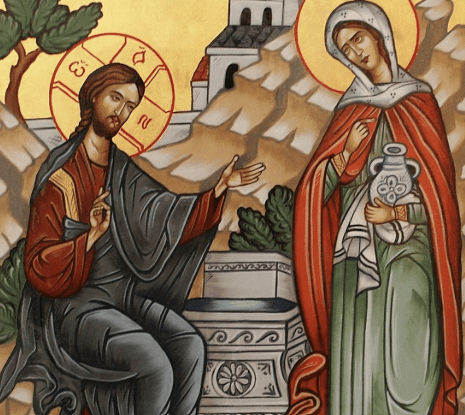
The Samaritan woman’s transformation begins when she allows Jesus to speak into her real life—not the religious version of herself, but her actual circumstances. She moves from hesitation to trust, from guarded conversation to courageous witness. By the end of the Gospel, she even leaves her water jar behind and runs back to her town proclaiming whom she has met. That detail matters. She leaves the jar—the very thing that gave her provision. Her trust became concrete because encounter leads to surrender. This is precisely the journey we are invited into as individuals and as a parish.
In last week’s readings, Abram trusted God enough to leave behind what gave him security. This week, the Israelites in the desert struggle to trust when water seems scarce, asking, “Is the Lord with us, or not?” Their question echoes in every generation—including ours. Saint Paul answers that question directly in today’s Second Reading: “The love of God has been poured into our hearts through the Holy Spirit.” God has already given Himself completely to us—we may simply not have experienced it yet.
Christian generosity is never payment to God; it is response to a love already received. This is why financial giving belongs alongside prayer and fasting as a pillar of Lent. Giving stretches trust beyond ideas into action. It asks whether we believe God will truly provide if we place Him first.
I invite you to consider percentage giving—offering God a known proportion of your income. This approach is biblical and spiritually formative, moving generosity from convenience to discipleship. I also continue to encourage Direct Debit giving, not simply for administrative stability but because it reflects a conscious, prayerful decision made in advance: “Lord, the first portion belongs to you.”
For some, the next step may be small but meaningful. If you give occasionally, perhaps regular giving is your invitation. If you already give regularly, perhaps increasing your gift as a sign of trust in God’s provision is the step.
Like the Samaritan woman, none of us are asked to have perfect faith before responding. Trust grows through concrete actions. Our parish is not sustained by obligation but built through shared mission. Every act of generosity helps create a community where people can encounter the living Jesus. Together, we are becoming more than a parish that maintains buildings or balances budgets—we are becoming a parish where lives are transformed through intimacy with Christ.
Stand with Him at the well. Listen for His voice. And ask: “What step of trust are you inviting me to take?” Because ultimately, I do not ask you to respond because the parish needs it; I invite you to respond because Jesus is offering living water—and trust in Him changes everything.
Peace and love — Fr Josh
Sponsors Of The Parish Newsletter: